In the age of AI, the best strategy fits on a single page – and demands conviction to execute it.
Legend has it that in 1980, Mike Scott, then president of Apple, sent an internal one-page memo with the subject line:
“Effective immediately!! No more typewriters are to be purchased, leased, etc.”
He added a clear goal:
“By 1-1-81, no typewriters at Apple. We believe the typewriter is obsolete. Let’s prove it inside before we try and convince our customers.”
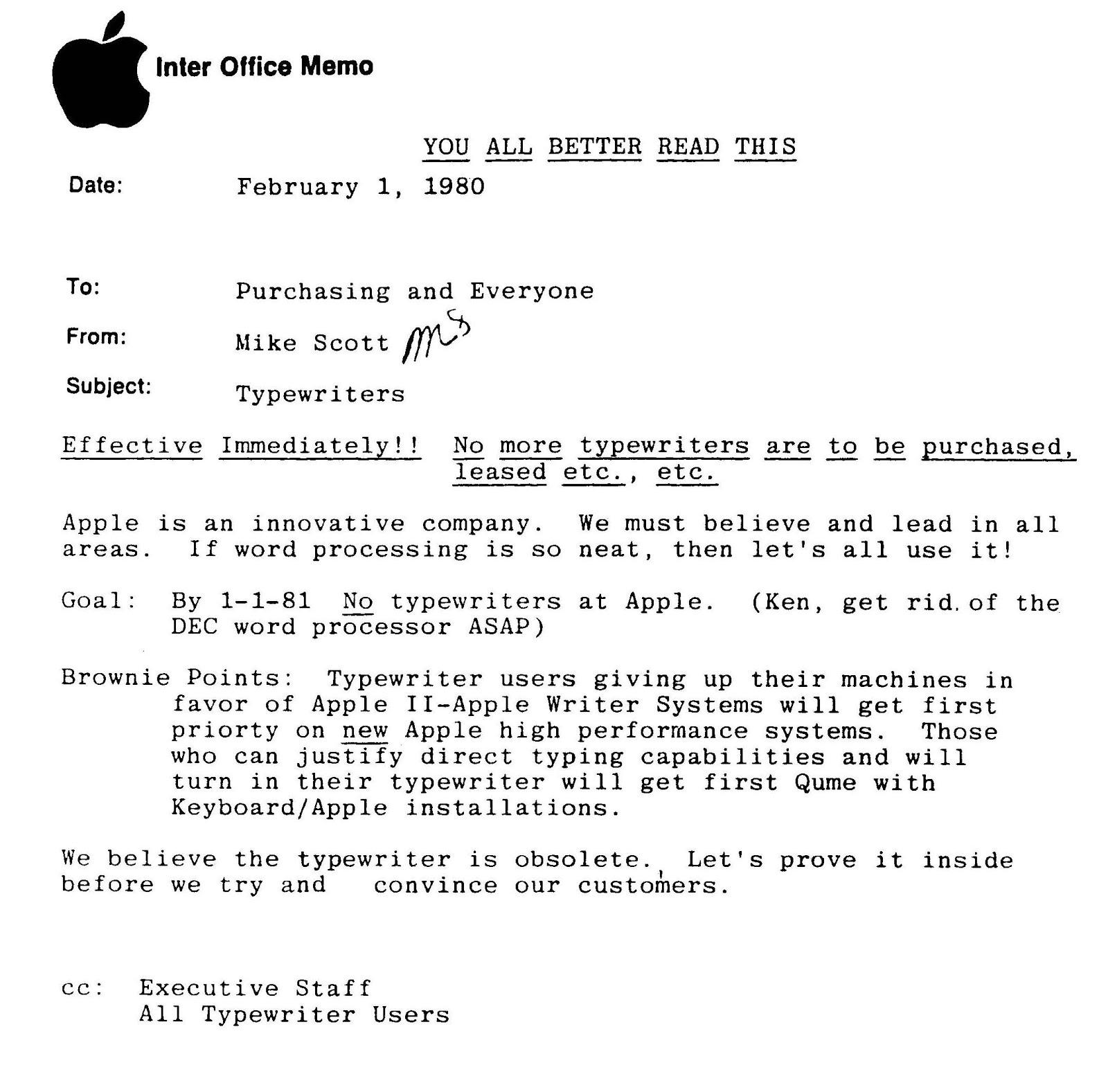
That was it. No matrices, no diagnostics, no endless plans.
One sentence was enough to capture a strategic direction:
If we want to change the world, we must start by changing how we work.
That memo explains better than any manual what a simple, living strategy means:
- It’s clear—everyone understands it.
- It’s relevant—it connects with the mission.
- It’s executable and measurable—it translates into immediate action.
Many of us have experienced the so-called “traditional” strategic planning process- too long, too expensive, and built on the illusion that the thicker the PDF, the stronger the strategy, as if more pages meant more control over the future. By the time that plan is finished, the world it was meant for has already changed.
Plenty of organizations remain trapped in the planning fallacy: believing that a bigger, more complex plan equals a better strategy.
This doesn’t mean we should fall into the tyranny of the tweet- 280 characters or less- but it’s clear that those massive PDFs once called strategic plans are now almost useless.
Just two years ago, the word ChatGPT didn’t mean much to most people. Today, according to the latest surveys, 65% of consumers in Latin America use AI, a technology capable of producing a full organizational diagnosis with real data in five minutes- something that would have taken a consultant countless hours not long ago.
And we all know this is only the beginning. Sam Altman, the kind of modern-day oracle now at the center of OpenAI’s power, recently said that the next 18 months will change everything in terms of AI’s impact. Back in 2022, we still used the term VUCA to describe Volatile, Uncertain, Complex, and Ambiguous environments. As I write this, at the end of 2025, VUCA already feels like a concept from the past.
In this new state of mega-volatility, planning three years ahead is a gamble; a five-year plan is pure madness.
Today’s strategy- any organization’s strategy- must serve a purpose.
Contemporary planning must focus on defining a shared “how.”
It’s not a list of tasks; it’s a common framework for acting, deciding, and adapting as everything changes.
This is where agile planning comes in- replacing rigidity with continuous learning cycles.
Planning is no longer about predicting; it’s about learning in motion.
Those nostalgic annual or semiannual “planning retreats” are now obsolete.
Today’s planning is iterative, and power lies in moving fast without losing meaning.
The Apple story is more than illustrative: eliminating typewriters wasn’t just about efficiency- it was a declaration of identity, written in a one-pager.
Every organization has its own “typewriter” it must let go of to move forward- and its own one-page memo it needs to write, so everyone knows which way to steer the ship.
Today, in the era of AI and permanent uncertainty, the essential strategic question is not “what will we do?” but rather:
How will we keep acting with clarity, agility, and purpose… and with deep commitment to execution?
The only strategy that truly matters is not the one that’s written- it’s the one that’s lived.
Perhaps the next great strategy won’t be measured by its length, but by how many people can explain it in a single sentence.
 Marco Villegas
Leave a comment